
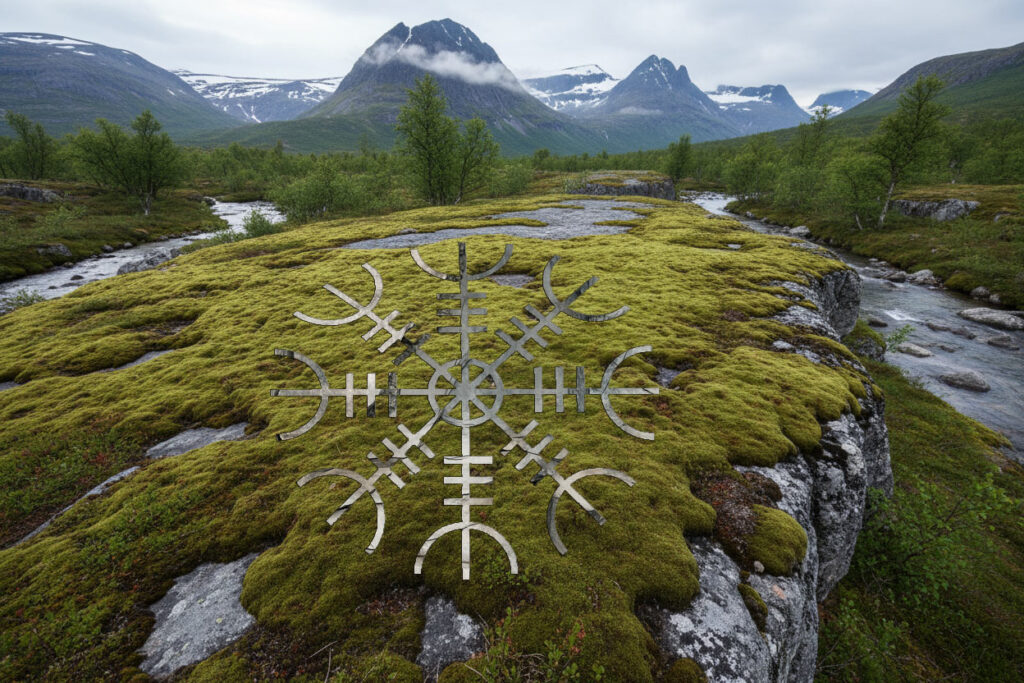
If you’ve been drawn to the Helm of Awe meaning, you’re probably not looking for “cute symbolism.” You want something that feels like armor.
The Helm of Awe (also called Aegishjalmur) is widely worn as a protection symbol—a sign of courage, dominance over fear, and fearless presence. Think: psychological shield. Not superstition. A reminder of who you are when life tries you.
Quick Helm of Awe meaning
Helm of Awe meaning: a symbol of protection + courage + unshakable presence.
People wear Aegishjalmur when they want to:
- Feel protected (energetically, emotionally, mentally)
- Hold their ground under pressure
- Walk into hard situations with a steady spine
- Stop shrinking, stop second-guessing, stop apologizing for their power
What is Aegishjalmur (Helm of Awe)?
Aegishjalmur (pronounced roughly EYE-gish-hyal-mur) is the Icelandic/Norse name often translated as “Helm of Awe.”
It’s commonly shown as a central point with eight arms radiating outward—like protection in every direction. No blind spots. No weak side.
You’ll also see it described as a magical stave (a protective sign) used to:
- Project strength
- Create a sense of intimidation (the “awe” factor)
- Guard the wearer from harm and fear
Where the Helm of Awe comes from (Norse magic + modern use)
The Helm of Awe is strongly associated with Norse magical tradition and is often discussed as a symbol connected to warriors and protection.
In modern life, most people aren’t going into battle with shields.
But you are walking into:
- Conflict
- High-stakes conversations
- Anxiety spirals
- Burnout
- Reinvention
- The pressure to perform
That’s why Aegishjalmur still hits. It’s a symbol that says: “I’m protected. I’m present. I’m not backing down.”
What the Helm of Awe is used for
1) Protection
This is the core. The Helm of Awe is worn as a protective boundary—especially when you feel exposed, drained, or surrounded by noise.
2) Courage (the kind that stays calm)
Not reckless energy. Not chaos.
More like: quiet power.
The kind that lets you do the hard thing without needing to prove anything.
3) Fearless presence
The “awe” isn’t about ego. It’s about presence that can’t be ignored.
If you’ve ever felt like you disappear in rooms, this symbol is the opposite message:
- I take up space.
- I’m not here to be tolerated.
- I’m here to be felt.
Helm of Awe meaning in modern life (identity + mindset)
Symbols work because they’re identity anchors.
When you wear the Helm of Awe, you’re not just wearing a graphic. You’re wearing a decision:
- I protect my energy.
- I stop negotiating with fear.
- I move like someone who’s already survived.
That’s why it fits the Black Rainbow Caps philosophy so cleanly: a wearable talisman—streetwear with a spine.
Helm of Awe is for you if…
Aegishjalmur might be your symbol if:
- You’re done being “nice” at the cost of your boundaries
- You’re stepping into leadership (even if it scares you)
- You want protection from other people’s projections
- You’re rebuilding confidence after a hard season
- You want to feel steady in your body again
How to wear/use the Helm of Awe with intention (simple rituals)
Keep it simple. The point is consistency, not ceremony.
- Before you leave the house: choose one word you’re protecting today (focus, peace, courage, discipline).
- When you feel pressure: touch the symbol and breathe once—slow. Tell yourself: “I’m protected. I’m here.”
- After a win: use it as a seal. “This is who I am now.”
Helm of Awe vs Vegvísir vs Valknut (which one fits you?)
These three get grouped together a lot, but they speak to different seasons:
- Helm of Awe (Aegishjalmur): protection + fearless presence (power under pressure)
- Vegvísir: guidance + wayfinding (staying on your path through uncertainty)
- Valknut: transformation + courage (facing fate, endings, rebirth)
If you want the vibe in one line:
- Vegvísir: “I won’t lose my way.”
- Helm of Awe: “I won’t be broken.”
- Valknut: “I’m not afraid of what I’m becoming.”
FAQ: Helm of Awe (Aegishjalmur) meaning
What’s the Helm of Awe meaning?
The Helm of Awe is widely worn as a symbol of protection, courage, and fearless presence—a reminder to hold your ground and move through fear.
Is Aegishjalmur the same as the Helm of Awe?
Yes. Aegishjalmur is the name commonly used for the symbol known in English as the Helm of Awe.
What is the Helm of Awe used for?
People use it for protection, confidence, and strength under pressure—especially when they want to reinforce boundaries and feel steady.
What’s the difference between Vegvísir and the Helm of Awe?
Vegvísir is more about guidance and finding your way. The Helm of Awe is more about protection and fearless presence.