If you’ve ever felt pulled toward the Ankh, it’s usually not random. The Ankh meaning is rooted in ancient Egyptian symbolism—often linked to life force, vitality, eternal life, and spiritual protection. In this guide, we’ll break down where it comes from, what it represents, and how people connect with it today.
Quick definition: The Ankh (often called the “Key of Life”) is an ancient Egyptian symbol associated with life force, vitality, eternal life, and spiritual protection. In temple art, it appears in the hands of deities—like a sign that life itself is a divine current you can receive, hold, and carry.
In this guide, we’ll break down the Ankh’s origins, its core meanings, and how to work with it respectfully—then we’ll bridge it into modern identity (and wearable symbolism) the Black Rainbow Caps way.
ANKH MEANING? (QUICK DEFINITION)
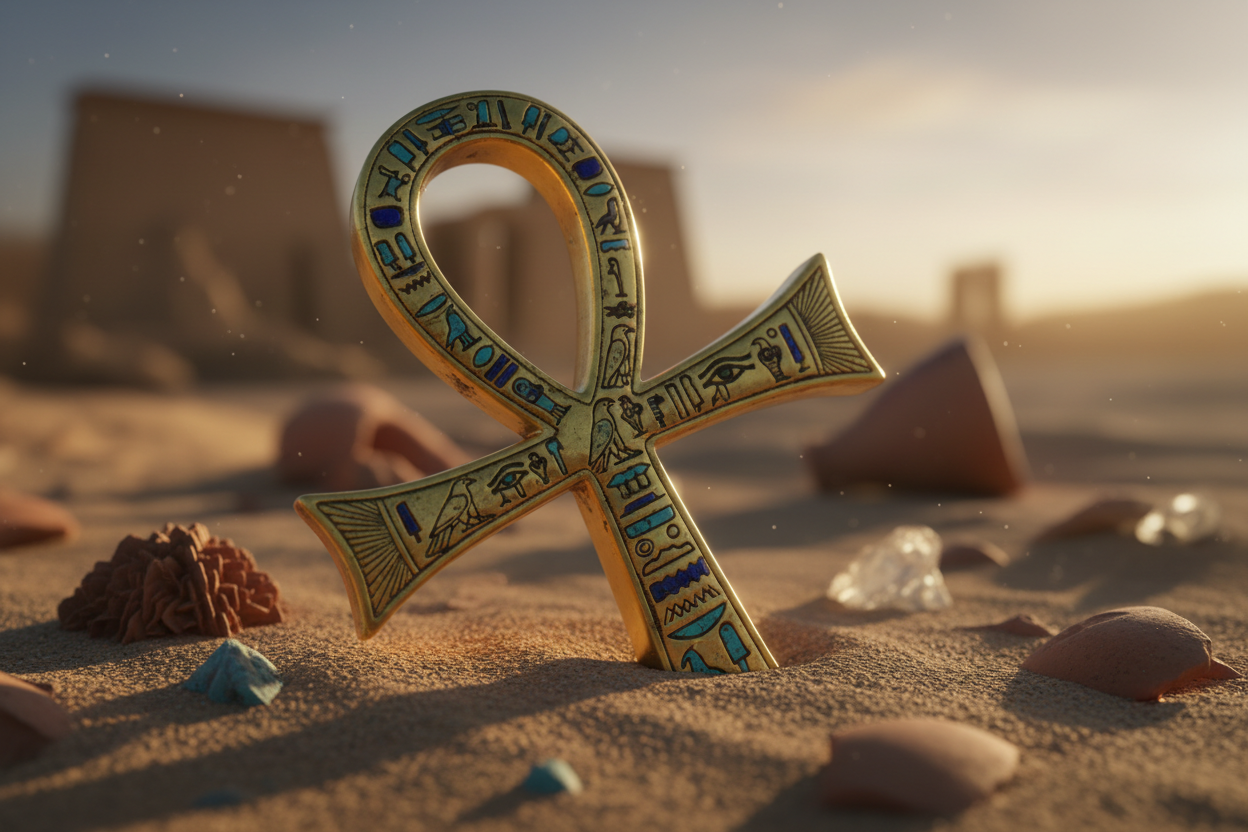
The Ankh looks like a cross with a loop at the top. Simple shape, massive symbolism.
At a glance, it’s often understood as:
- Life force (the spark that animates you)
- Vitality and renewal (the ability to regenerate and keep going)
- Eternal life (continuity beyond a single moment)
- Protection (spiritual resilience, energetic boundaries)
If you’re here because you searched ankh meaning or what does the ankh mean, this is the headline: the Ankh is a symbol of life—lived with power, protected with intention.
ANCIENT EGYPTIAN ORIGINS — WHERE THE ANKH COMES FROM
In ancient Egyptian art, the Ankh appears everywhere: carvings, temple walls, sacred imagery. It’s commonly shown being held by gods and goddesses, sometimes near the mouth or nose—like a visual metaphor for the breath of life.
This is why the Ankh doesn’t read as “decoration.” It reads as authority.
In that world, symbols weren’t just aesthetic. They were functional. They carried meaning, protection, and spiritual technology—encoded into shape.
CORE ANKH MEANING — LIFE FORCE, VITALITY & ETERNAL LIFE
The Ankh is often translated as the Key of Life, and that phrase matters.
Because “life” here isn’t just survival. It’s:
- Creative power (the ability to build, make, and become)
- Continuity (the thread that connects who you were to who you’re becoming)
- Renewal (the return after the fall)
That’s why the Ankh resonates so strongly during transition seasons: new chapters, identity shifts, recovery, reinvention.
If you’re drawn to the Ankh, you may be craving a reminder that your life force is not fragile—it’s ancient.
SPIRITUAL MEANING OF THE ANKH — PROTECTION, BALANCE & SACRED POWER
Many people search for the spiritual meaning of the Ankh because they feel it as more than history.
In modern spirituality, the Ankh is often interpreted as:
- Protection: not as fear, but as boundaries. A symbol that says: “My energy is mine.”
- Sacred power: a reminder that you can move through life with intention.
- Balance: some interpret the loop and cross as a meeting point of forces (spirit/matter, above/below, inner/outer).
Historically, the Ankh is strongly tied to life-giving power in ancient Egyptian symbolism. In modern spiritual practice, many people also choose to work with the Ankh as a personal talisman—an emblem of vitality and protection they carry as a daily reminder.
Important note: these are interpretations, not one single official definition of the Ankh meaning. The Ankh has lived across centuries, cultures, and personal belief systems—so it tends to meet you where you are.
MODERN ANKH MEANING — IDENTITY, STYLE & PERSONAL POWER
Symbols survive because they keep telling the truth.
Today, the Ankh shows up in streetwear, tattoo culture, spiritual communities, and art-driven fashion because it communicates something instantly:
- You’re not here to blend in.
- You’re building a life that’s yours.
- You protect your peace because it’s sacred.
It’s especially meaningful for people who treat style as identity—who wear symbols like a language.
If that’s you, the Ankh isn’t a trend. It’s a signal.
DESIGN LAYERS — HOW BLACK RAINBOW CAPS TRANSLATES THE ANKH INTO WEARABLE ART
At Black Rainbow Caps, we don’t use symbols as surface-level graphics. We treat them as stories you can wear.
Our approach to symbolic design is always layered:
- Ancient authority: the symbol has roots, weight, and history.
- Meaning-first composition: the design is built to say something, not just look cool.
- Hidden motifs: secondary details that reward the people who look closer.
- Modern identity bridge: the piece has to feel at home in real life—streetwear, daily fits, bold minimalism.
THE BLACK RAINBOW CAPS ANKH — THE INTENTION BEHIND THE DESIGN
When we created our Ankh design, we didn’t want it to be “just an Ankh.” We wanted it to feel like a complete energetic story—life force + protection + creation—woven into one wearable talisman.
That’s why our design merges three intentional layers:
- The Ankh (Key of Life) — the core current: vitality, continuity, and the courage to keep becoming.
- Goddess Eye — the guardian layer: intuition, discernment, and a protective presence that feels awake.
- The (Golden) Flower of Life — the blueprint layer: harmony, unity, and the sense that your life is part of a larger pattern.
Together, these elements are intended to feel mystical, ancient, and alive—without losing the clean, bold clarity that makes the symbol wearable in modern streetwear.
HOW TO WORK WITH THE ANKH SYMBOL (RESPECTFULLY)
Wearing ancient symbols can be powerful—and it should also be thoughtful.
Here’s a grounded way to approach it:
- Learn the roots. Even a basic understanding of ancient Egyptian context adds respect.
- Avoid making claims you can’t support. It’s okay to say “I interpret it as…”
- Wear it with intention, not costume energy. If it’s meaningful to you, treat it that way.
- Let the symbol be a reminder, not a shortcut. Protection symbols work best when paired with real boundaries.
Respect isn’t about perfection. It’s about sincerity.
WEAR THE LIFE FORCE
If the Ankh speaks to you, it’s usually because you’re stepping into a new version of yourself.
Life force. Protection. Power. Not borrowed—claimed.
Explore our Spiritual/Mystical Symbols collection and find the piece that feels like your key.
Face the day. Wear life. Wear protection.
FAQ — ANKH MEANING (QUICK ANSWERS)
What does the Ankh mean?The Ankh is an ancient Egyptian symbol commonly associated with life, vitality, and eternal life. Many people also connect it to spiritual protection and personal power.
What is the spiritual meaning of the Ankh?In modern spirituality, the Ankh is often interpreted as a symbol of life force, energetic protection, and intentional living. People use it as a reminder to protect their peace and stay connected to purpose.
Is the Ankh a symbol of protection?It can be. Historically, the Ankh is strongly tied to life and divine power in ancient Egyptian symbolism. Today, many people also view it as a protective emblem—especially in the sense of boundaries and spiritual resilience.
Why is the Ankh called the “Key of Life”?The phrase “Key of Life” reflects the Ankh’s association with life-giving power, vitality, and continuity. In ancient art it’s often shown in divine hands, suggesting life as a sacred force that can be granted and carried.
What’s the difference between the Ankh and a Christian cross?The Ankh is an ancient Egyptian symbol with a loop at the top and meanings tied to life force and vitality. A Christian cross is associated with Christian theology and the crucifixion. They may look similar at a glance, but they come from different traditions.
Is it disrespectful to wear the Ankh?Wearing the Ankh can be respectful when it’s done with intention and basic understanding. Avoid treating it like a costume symbol, and be mindful about separating historical meaning from modern interpretations.
What does an Ankh tattoo mean?An Ankh tattoo often represents life, rebirth, spiritual power, or protection. For many people, it marks a new chapter—survival, transformation, or a commitment to living with purpose.